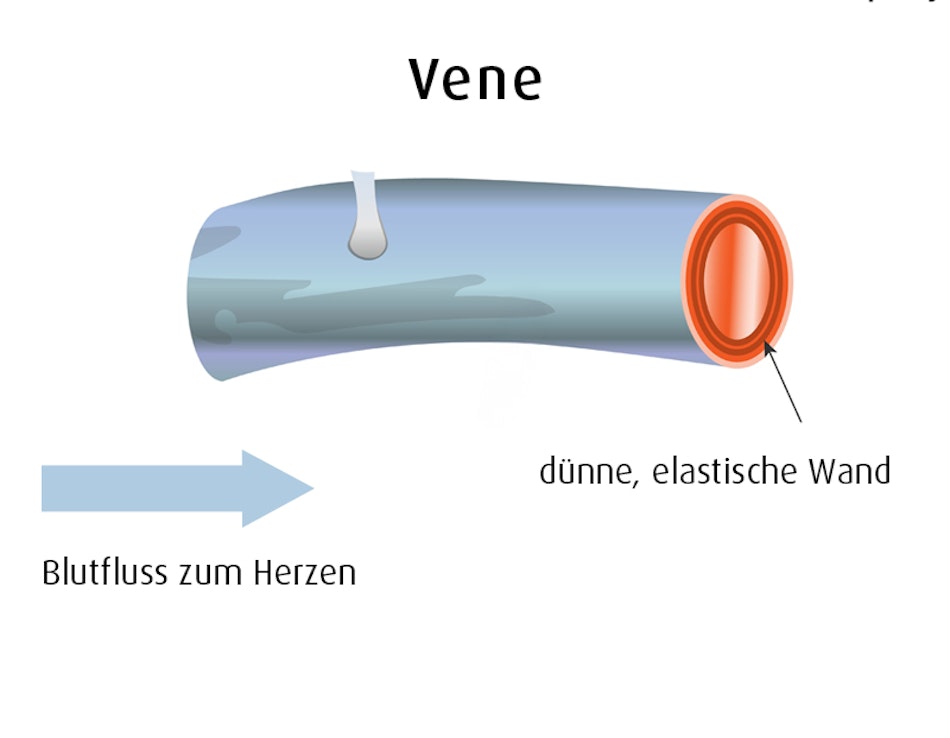
Veins
Veins carry blood back to the heart. Since the pressure in the veins is lower, muscle movements and venous valves, among other factors, help return the blood to the heart.

The cardiovascular system supplies the entire body with oxygen and nutrients. At its center is the heart: a powerful muscle that continuously pumps blood through a vast network of blood vessels.
The heart, blood, and blood vessels work closely together in this process. They supply organs, muscles, and tissues with blood, transport hormones, and remove metabolic waste products. The circulatory system also helps regulate body temperature and fluid balance.
The cardiovascular system includes:
Through its pumping action, the heart generates the pressure needed to allow blood to flow through the blood vessels. The blood vessels form the transport system that reaches every part of the body.
The heart is protected behind the breastbone, slightly to the left of the body's midline. It consists mainly of heart muscle tissue and works day and night without us having to consciously control its activity.
Inside, the heart is divided into four chambers:
The atria receive the blood flowing back to the heart. The ventricles then pump it on to the lungs or into the systemic circulation.
Four heart valves ensure that blood flows in the right direction. They open and close in time with the heartbeat, functioning like valves.
Every heartbeat is triggered by an electrical impulse. The heart's natural pacemaker is the sinus node, located in the right atrium.
From there, the electrical signal spreads throughout the heart. It ensures that the atria and ventricles contract in a coordinated sequence.
The heart functions largely on its own. However, its rhythm is influenced by the autonomic nervous system and various hormones. That is why the heart rate changes depending on the situation:
The heart's electrical activity can be recorded using an electrocardiogram, or ECG for short.
Blood circulates through the body in two interconnected systems.
The right side of the heart pumps oxygen-poor blood into the lungs. There, the blood releases carbon dioxide and takes in fresh oxygen. It then flows back to the left side of the heart.
The left side of the heart pumps oxygen-rich blood through the aorta into the body. Organs and tissues absorb oxygen and nutrients. The blood, now lower in oxygen, then flows back through the veins to the right side of the heart.
Both circuits operate simultaneously and together form a closed system.
Veins carry blood back to the heart. Since the pressure in the veins is lower, muscle movements and venous valves, among other factors, help return the blood to the heart.

Capillaries are the smallest blood vessels. Their exceptionally thin walls allow for the exchange of oxygen, nutrients, and metabolic byproducts between the blood and tissues.

Arteries carry blood away from the heart. Their walls are strong and elastic so that they can withstand the pressure generated with every heartbeat.
The largest artery is the aorta. It carries blood from the left ventricle to the rest of the body.
Blood vessels carry blood throughout the body. Depending on their structure and function, they are classified as arteries, veins, and capillaries.
In order for blood to flow through the blood vessels to organs and tissues, it must be under pressure. This blood pressure results from the interaction of:
When measuring blood pressure, two numbers are given.
The upper, systolic value occurs when the heart contracts and pumps blood into the arteries.
The lower, diastolic value is measured when the heart muscle relaxes and refills with blood.
Blood pressure is not always the same. It changes in response to factors such as exercise, rest, stress, sleep, and temperature fluctuations.
The pulse is the pressure wave that travels through the arteries with each heartbeat. It can be felt, for example, at the wrist or on the side of the neck.
Your pulse indicates how often your heart beats per minute and whether the rhythm appears regular. It is influenced by, among other things:
Heart rate and blood pressure are not the same thing. A fast heart rate does not automatically mean that blood pressure is also elevated.
The cardiovascular system constantly responds to the body's needs. During exercise, muscles need more oxygen. As a result, the heart beats faster and pumps more blood through the body.
When standing up, the circulatory system must quickly adapt to the change in body position. In warm conditions, the blood vessels in the skin dilate so that the body can release heat. In cold conditions, they tend to constrict.
The following entities, among others, are involved in this regulation:
Mild, short-term fluctuations are normal. However, recurring symptoms such as dizziness, fainting, severe palpitations, or marked fatigue should be evaluated by a doctor.

Various diseases and risk factors can interfere with the interaction between the heart, the circulatory system, and the blood vessels.
These include, among other things:
Persistently high blood pressure can put a strain on the heart and blood vessels. Low blood pressure generally does not cause comparable vascular damage, but it can be associated with symptoms such as dizziness, fatigue, or circulatory problems.
Changes and deposits in the arteries can restrict blood flow. Important modifiable risk factors include, among others, smoking, high blood pressure, lack of physical activity, and abnormal metabolic levels.
If the heart can no longer pump enough blood throughout the body, physical performance declines. Shortness of breath, unusual fatigue, or fluid retention may be signs of this condition and should be evaluated by a doctor.
A heart-healthy lifestyle not only supports the heart, but also helps maintain healthy blood pressure, blood vessels, and metabolism.
Key fundamentals include:
Hawthorn (Crataegus monogyna and Crataegus laevigata) has traditionally been closely associated with heart and circulatory health. Depending on the preparation, the leaves, flowers, or fruits are used. In the plant encyclopedia, you can learn more about the botany, active ingredients, history, and traditional uses of hawthorn.
Heart and circulatory problems can have various causes. Prompt medical evaluation is especially important in the following cases:
If you experience sudden, severe, or life-threatening symptoms, seek medical help immediately.
What exercise, nutrition, sleep, stress management, and preventive care mean for heart health.
What high and low blood pressure mean and how circulatory problems can manifest themselves.
How blood vessels are structured, what puts a strain on them, and what a lifestyle that’s good for your blood vessels might look like.
